
PATIENT-REPORTED OUTCOMES SOFTWARE + MANAGED SERVICES
More Than PROMs Software. An Entire Program, Managed for You.
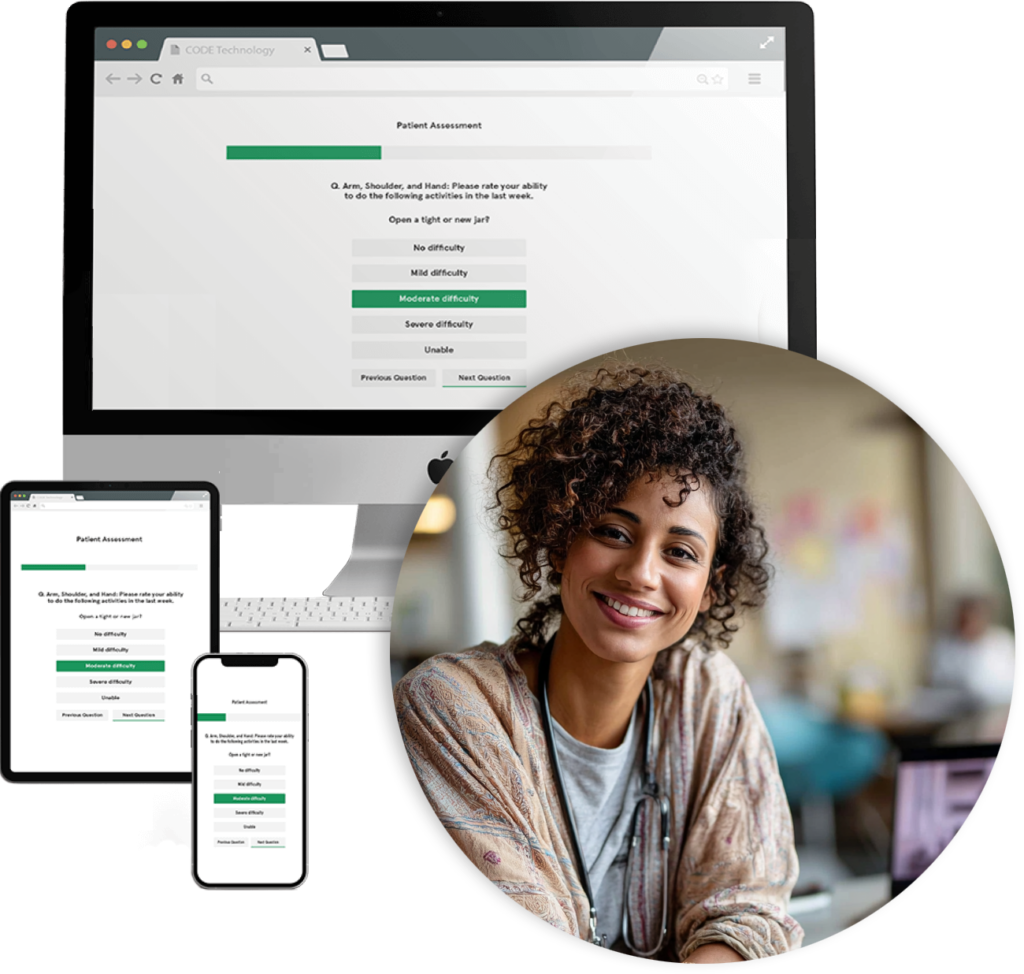
Patient-reported outcomes software should reduce work – not leave your team managing patient reminders, data gaps and reporting risk. CODE combines its platform with clinical expertise and dedicated operations to keep outreach moving, data complete and reporting on track.
Common Challenges with Software-Only Approaches
Patient-Reported Outcomes Software vs. Fully Managed PROMs:
Who Owns the Work?
Software can automate surveys. CODE provides the technology, clinical expertise and daily operational management required to keep patients engaged, data complete and reporting on track.
| Responsibility | Software-only platform | Fully-managed PROMs with CODE |
|---|---|---|
| Technology | Platform provided; your team manages it | Platform included; CODE manages it |
| Patient enrollment | Your team identifies and enrolls eligible patients | CODE manages and automates patient enrollment |
| Patient outreach | Automated email and text tools; your team manages outreach strategy | CODE strategically manages email, text, and U.S.-based phone outreach to optimize engagement and prevent over-surveying (or survey fatigue) |
| Nonresponse recovery | Hospital follows up | CODE actively recovers nonresponses |
| Collection requirements | Your team monitors dashboards and manages collection requirements | CODE monitors and intervenes before required collection windows close. |
| Data quality | Your team reviews and cleans program data | CODE continuously monitors and validates data to maintain program and registry health |
| CMS reporting | Your team prepares and manages CMS reporting | CODE manages reporting requirements and prepares data for CMS submission |
| Registry reporting | Your team prepares and submits registry data | CODE prepares and submits data to supported registries |
| Benchmarking and analysis | Analysis limited to your team’s resources and the vendor’s available dataset | CODE provides risk-stratified analysis and national benchmarking using more than a decade of orthopedic outcome data |
| Strategic program review | Your team interprets results and determines next steps | CODE provides quarterly strategic reviews with trends, benchmarks, and actionable recommendations |
| Payer and quality programs PRO requirements | Your team monitors evolving requirements and determines necessary program changes | CODE monitors evolving CMS, payer, and registry requirements and adapts program accordingly |
CODE clients spend fewer than 10 hours per year managing their PROMs program. For every 300 patients, CODE handles more than 615 operational tasks—helping clients avoid monthly workload equivalent to an average of 3.2 full-time employees.
Get an estimate of your PROMs staffing savings and ROI with a fully-managed approach.
Run a High-Performing PROMs Program
Without Adding to Your Workload or Headcount
Most PROMs vendors sell software your team has to implement, manage, and maintain. CODE delivers a fully-managed PROMs service—combining technology, clinical expertise, and dedicated operations to run the program for you.
Your operational partner
A dedicated account manager, not a ticket queue.
Every CODE client works with a dedicated U.S.-based account manager with a capped client load — proactively managing your program, not reactively responding to tickets. Clinically trained and embedded in your outcomes data daily, with quarterly strategic reviews included.
CODE’s Managed PROs:
Faster, Easier, Better ROI
Rethinking your PRO strategy? Switching to CODE is simple—and the payoff starts fast.
Go live in 30 days with a fully managed PROMs program that helps you meet reporting requirements, improve quality performance and reduce staff workload – without disrupting existing workflows.

Trusted Results
89% Net Promoter Score
Proven satisfaction.
120+ Years of Clinical Expertise
Partner with experts who understand outcomes and quality reporting.
Seamless Technology
EHR-Agnostic Integration
Your workflows stay intact—no extra IT burden.
24/7 Access to Actionable Data
Track pain, function, and quality of life; PROM scores live in your EHR.
Insights & Benchmarking
National Registry Benchmarking
Compare outcomes against peers with CODE’s extensive datasets.
Transform Data into Action
Improve care decisions, strengthen quality, and boost market position.

Reporting & Accreditation Simplified
CMS PRO-PM/MIPs & AAOS Reporting Made Easy
Automated workflows and expert oversight
for accreditation and advanced certifications.
Future-Proof Your PRO Program
CMS is expanding. Build a program that scales across service lines.
CMS is focused on hips and knees today, but is expanding PRO requirements to spine, cardiac and more. Traditional EHR workflows can’t scale—and hiring more staff isn’t sustainable.
See the full program in 30 minutes.
In one call, we’ll show you how CODE manages the 615+ monthly operational tasks your staff would otherwise own—and how complete, validated PRO data can improve capture rates, reduce workload, support quality improvement and help protect your APU.
Frequently Asked Questions about patient-reported outcomes.
What is patient-reported outcomes software?
Patient-reported outcomes software is technology used to collect, manage, analyze and report health information provided directly by patients. Patients complete validated patient-reported outcome measures (PROMs) electronically to report symptoms, pain, physical function and quality of life without interpretation by a clinician.
Effective patient-reported outcomes software supports mobile-friendly surveys, longitudinal collection schedules, automated outreach, capture-rate monitoring, data validation, healthcare system integration, benchmarking and reporting. Some solutions provide only the technology, while fully managed PROMs services also handle patient identification, outreach, nonresponse recovery, data-quality issues and reporting preparation.
What should healthcare organizations look for in a PROMs vendor?
Healthcare organizations should evaluate a PROMs vendor based on measurable performance, operational responsibility, integration capabilities and reporting support—not software features alone.
Ask who will own patient identification, survey configuration, outreach, nonresponse follow-up, collection-window monitoring, duplicate-survey prevention, data anomaly resolution and reporting preparation. Organizations should also evaluate implementation time, healthcare system integration, data security, validated measures, capture rates, risk-stratified analysis and access to meaningful benchmarks. A strong PROMs vendor should clearly distinguish between what its technology automates, what its team manages and what work will remain with hospital staff.
What are the best tools for collecting electronic patient-reported outcomes?
The best tools for collecting electronic patient-reported outcomes combine accessible survey technology with reliable patient engagement, data-quality controls and reporting capabilities. The right ePRO solution depends on whether the organization is supporting clinical research, routine patient care, quality improvement or regulatory reporting.
For hospital PROMs programs, important capabilities include mobile-friendly surveys, email and text outreach, telephone follow-up, validated measures, real-time collection monitoring, longitudinal scheduling, healthcare system integration and reporting-ready data. A software-only ePRO platform may work for organizations with staff available to manage the program. A fully managed solution is better suited to organizations that want the vendor to expertly manage collection, follow-up, validation and reporting operations.
Can patient-reported outcomes software integrate with existing healthcare systems?
Yes. Patient-reported outcomes software can integrate with electronic health records, clinical data warehouses, registries and other healthcare systems through methods such as HL7 interfaces, APIs, SFTP and secure file exchange.
Integration can automate the transfer of patient demographics, procedure information, survey schedules and completed outcomes data. However, technical connectivity alone does not guarantee a successful PROMs program. Organizations should also determine who will monitor failed transfers, correct data anomalies, prevent duplicate surveying and validate that the correct patients and collection windows are being tracked. The strongest integrations combine reliable data exchange with clearly assigned operational responsibility.
What are the biggest challenges in implementing an ePRO program?
The biggest challenges in implementing an ePRO program are maintaining patient engagement, managing longitudinal follow-up, integrating clinical data and assigning responsibility for daily execution. Installing the software is often the easiest part.
Organizations may struggle to identify every eligible patient, collect surveys after patients leave the hospital, monitor expiring collection windows, prevent survey fatigue and duplicate outreach, resolve data anomalies and prepare complete data for quality or regulatory reporting. These responsibilities can create substantial work for clinical, quality and IT teams. A successful ePRO program requires both capable technology and a defined operating model for outreach, exception management, data validation and continuous improvement.
What is the difference between PROMs software and a fully managed PROMs service?
PROMs software provides the technology for collecting, monitoring and reporting patient-reported outcomes, while a fully managed PROMs service also provides the people and operational expertise required to run the program.
With software alone, hospital staff typically remain responsible for identifying eligible patients, managing outreach, recovering nonresponses, monitoring collection windows, resolving data anomalies, preventing duplicate surveys, validating data and preparing reports. A fully managed PROMs service performs these day-to-day responsibilities on the organization’s behalf. This combination of technology and operational support can improve capture rates, produce more complete and reliable data and reduce the workload placed on clinical, quality and IT teams.